Governor Bala Mohammed: Transforms Healthcare, Security, Education, Housing, Improve infrastructure
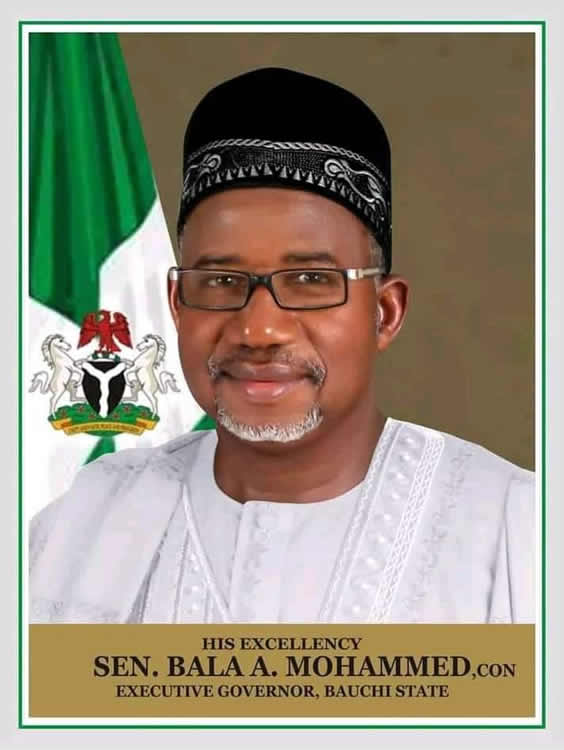
Background and Educational Journey
Governor of Bauchi State, Senator Bala Abdulkadir Mohammed CON was born on October 5, 1958, in Duguri Town, located in the Alkaleri Local Government Area of Bauchi State. Little did his family realized that a future of distinction was ushered in with the birth of the esteemed governor.
He attended Duguri Primary School in Bauchi from 1965 to 1971. Following that, he attended Government School Bauchi for his secondary education between 1972 to 1976. In 1979, he received his advanced level testimonial from North East College of Art and Science, and subsequently earned his Bachelor of Arts degree from the University of Maiduguri
Career Journey
Governor Mohammed commenced his professional journey as a journalist in 1982, serving as the news editor for the Mirage Newspaper, a news reporter for the News Agency of Nigeria (NAN), and as the state bureau chief responsible for Benue at the Democrat Newspaper from 1983 to 1984.
He transitioned to the civil service, taking on the role of an administrative officer at the Federal Ministry of Internal Affairs, where he remained until 1994. He then advanced to the presidency (cabinet secretariat) as the principal administrative officer. Mohammed’s ascent through the ranks of the civil service was swift. From 1995 to 2005, he progressed from chief supplies officer at the Federal Ministry of Solid Minerals to assistant director at the Federal Ministry of Power and Steel, deputy director/special assistant to the Honourable Minister at the Federal Ministry of Transport, director of administration at the Nigerian Railway Corporation, special assistant to the Honourable Minister of Aviation, and finally, director of administration and supplies at the Nigerian Meteorological Agency.
He voluntarily retired from the civil service at the rank of director and subsequently ventured into politics.
Professional and Political Evolution
In 2007, Mohammed contested and won the election to serve the people of Bauchi South Senatorial zone as a senator under the party platform of the All Nigeria Peoples Party (ANPP) from 2007 to 2010.
He reportedly fell out with political godfather former governor Isa Yuguda after Yuguda married President Umaru Musa Yar’Adua’s daughter.
Following the death of Musa Yar’Adua, Mohammed joined the Peoples Democratic Party (PDP) and became a close associate of former President Goodluck Jonathan.
While at the senate chamber, he became one of the foremost outspoken legislators in Nigeria. Mohammed sat as a member of eight committees – he was the vice chairman of the Senate Committee on Aviation and secretary of the Northern Senator’s Forum (NSF).
The committees included communication, finance, public account, rules and business, environment, labour and productivity.
February 10, 2010, Mohammed supported the “doctrine of necessity” in the senate that led to the emergence of Vice President Goodluck Jonathan as the acting president.
April 6, 2010, Mohammed became the Minister of the Federal Capital Territory (FCT). While at the FCT, he brought extensive reforms. Among the reforms were the sanitization of the land administration of the FCT, comprehensive expansion of the major road accessing the Nnamdi Azikiwe Airport Road to the international airport in Abuja, the construction of the Kubwa Expressway, the rail track from Abuja to Kaduna, and the Idu Rail Station. He also introduced the land swap policy, where land was used as a resource to fast-track infrastructural development in the FCT.
The administration of the FCT, led by Mohammed, was responsible for the installation of solar panel traffic lights. Additional projects undertaken included the establishment of satellite towns and the completion of the Usama Dam Water Project. Furthermore, his administration introduced innovations that became the foundation for financial stability and job creation, such as the FCT Internal Revenue Board, the Outdoor Advertising (Signage) Agency, and the FCTA Emergency Services.
After Mohammed’s departure as Minister of the FCT in May 2015 and the subsequent change of the ruling party at the Presidential Villa in Aso Rock, Abuja, anti-corruption agencies initiated a crackdown on the former minister. In October 2016, the Economic and Financial Crimes Commission (EFCC) apprehended Mohammed and held him in custody for 49 days. An Abuja High Court located in Maitama ruled that the detention was illegal and unconstitutional, mandating the EFCC to compensate him with the sum of N5 million. Mohammed asserted that his detention was “a clear case of witch-hunt linked to the role he played in the implementation of the ‘doctrine of necessity’,” intended to damage his reputation and hard-earned credibility.
On May 29, 2019, Mohammed took the oath of office as the governor of Bauchi State under the banner of the PDP, having triumphed over the incumbent governor, Mohammed Abdullahi Abubakar, with a vote count of 515,313 to 500,625. This victory was later affirmed by the Supreme Court on January 20, 2020.
He built the first flyover in Bauchi State, and following his inauguration, Mohammed streamlined governmental processes and protocols, as well as recover lost or misappropriated government assets and funds from the previous administration.
Additionally, he initiated a program to eliminate ghost workers from the Bauchi State Civil Service and subsequently formed a committee to verify the Bank Verification Numbers (BVN) of civil servants, which revealed the presence of ghost workers on the payroll.
Governor Mohammed was resolute in his efforts to enhance the education and health sectors within the state, tackling the challenge posed by over 1.3 million children who are out of school and hospitals that are not operational.
Under Governor Mohammed’s guidance, the health sector has experienced significant transformation. Numerous general hospitals and primary healthcare centers have been built or refurbished, guaranteeing access to quality healthcare throughout the state.
The prominent “Bauchi Healthcare Revival” initiative aims to deliver healthcare services within a reasonable distance for every community.
These initiatives have resulted in a reduction in maternal and infant mortality rates. The government introduced the Kaura Economic Empowerment Programme (KEEP), which focuses on providing women and youth with grants, loans, motorcycles, grinding machines, sewing machines, and buses, among other resources.
The government innitiated investments from NEXIM Bank and agricultural enterprises to enhance commercial farming within the state.
Mohammed inaugurated the construction of 2,500 affordable homes in Dungal Village, situated in the Bauchi Local Government Area. His government also built connecting roads throughout the state.
As Governor Bala Mohammed commemorates six years in office, Bauchi State acknowledges a transformative period characterized by significant advancements across various sectors. His administration’s dedication to inclusive governance and sustainable development has greatly enhanced the quality of life for the residents of the state.
Governor Mohammed’s administration has placed a strong emphasis on education, resulting in a notable decrease in the number of out-of-school children from 1.2 million to around 521,000. Over 300 primary and secondary schools have been either renovated or constructed, and more than 5,000 classrooms have been built.
The government has also recruited and retrained teachers, thereby improving the quality of education.
Financial assistance has been provided to more than 14,000 students, covering fees for WAEC, NECO, JAMB, NBAISE, and NABTEB. Furthermore, the administration has upgraded examination infrastructure and offered ICT training to both students and teachers, equipping them for a digital future.
In an effort to rejuvenate the agricultural sector, the administration has produced over 8,000 metric tons of fertilizer and trained 1,000 young farmers in contemporary techniques. The distribution of fertilizer to more than 10,000 farmers has significantly enhanced farm produce, establishing Bauchi as a hub for food production.
Water is essential for life, and in partnership with the World Bank, the government has implemented a ₦20 billion water project aimed at improving water supply in Bauchi metropolis. Key elements of this project include a 150-kilometer pipeline distribution, the installation of 1,000-millimeter diameter transmission mains from Gubi Dam to Warinje reservoir, and the construction of seven million-liter reservoirs at Buzaye Hill. Additionally, over 3,000 hand boreholes have been drilled in various locations across the 20 local government councils of the state to alleviate the issue of water scarcity.
Governor Mohammed has also strengthened security measures by providing military and paramilitary agencies with more than 50 operational vehicles, thereby enhancing their operational capabilities. The administration has also initiated the recruitment of 2,000 hunters across 20 LGAs to aid in the fight against banditry and other criminal activities, further contributing to Bauchi’s standing as one of Nigeria’s most peaceful states.
The administration has prioritized the enhancement of power supply at the Yankari Game Reserve to foster tourism. Initiatives include the development of infrastructure designed to attract tourists and investors, capitalizing on Bauchi’s rich cultural heritage and natural attractions. Bauchi Metropolis and other urban areas have benefited from the solar power project aimed at improving security and visibility.
Governor Mohammed’s administration has cultivated collaborations with various international organizations, such as the World Bank, UNICEF, the People’s Republic of China, Canada, the United Kingdom, and the United Arab Emirates, among others, to execute projects in the fields of education, healthcare, and infrastructure, thereby improving the state’s development trajectory.
Through the Kaura Economic Empowerment Programme (KEEP), the government has initiated sustainable projects:
– Distribution of 156 commercial buses to members of the NURTW across 20 local government areas (LGAs).
– Distribution of 1,500 tricycles to Okada Unions to assist local entrepreneurs.
– Implementation of a micro-grant scheme that provides ₦50,000 each to small traders to bolster their businesses.
– Launch of the ₦75 million KEEP initiatives for youth and women empowerment in each of the 20 LGAs.
– Allocation of ₦500 million in soft loans to traders and artisans, along with numerous other initiatives.
Infrastructure:
Construction of a 29km road connecting Boi-Gambar-Sara-Marti to Lere.
Rehabilitation of the 29km Dindima-Yashi-Maina Maji road.
Dualization of the 5.2km road from the Emir’s Palace in Azare to the Setraco roundabout.
Dualization of a 7km road from A.D Rufa’i College to Misau town.
Construction of the 2.6km Gwallameji-Doka-Rafin Zurfi-Dass road.
Construction of the 4.5km Sabon Kaura-Birshi Gandu-BRC road.
Construction of a 1.1km road in Bayara township.
Construction of the 4km Zango-Gwallagan-Mayaka access road.
Construction of the Shari’a Court of Appeal.
Construction of the 22km Darazo-Gabciyari road.
Construction of a 2.6km internal road at Bauchi State University Gadau.
Rehabilitation of the 29km Adamani-Disina road in the Jama’are local government area.
Construction of the 42km Geljaule-Lame road.
Rehabilitation and upgrading of the Emirs’ Palaces located in Bauchi, Jama’are, Ningi, and Dass.
Last line
Governor Bala Mohammed’s administration exemplifies a governance model founded on accountability, integrity, inclusiveness, and strategic planning. It has achieved significant milestones in infrastructure and has been recognised as the Most Security Conscious Governor of The Year 2025 by Creekvibes Magazine.
The administration prioritizes youth empowerment, sustainability, and development, with education being a critical focus. His government has successfully facilitated the return of out-of-school pupils to classroom and has worked to maintain their attendance. In terms of health, the administration is committed to providing maximum healthcare access for all residents throughout the state.
Under his leadership, public service is being redefined, instilling a renewed sense of confidence in governance among residents. His youth-oriented approach serves as a pathway toward sustainable development.
Compiled by Daniel Ekiye