
How Safe is Nigerian Airspace?
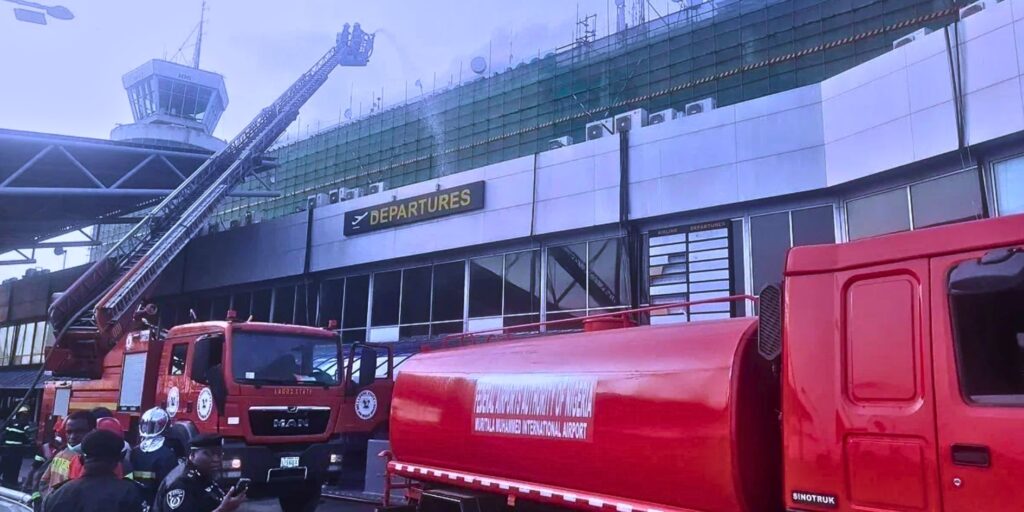
•Fire outbreak at Murtala Muhammed International Airport exposes deeper questions…

Safety in aviation is not a matter of perception; it is a function of systems integrity, human performance, regulatory compliance, and the reliability of critical infrastructure.
In Nigeria, that question—how safe is the nation’s airspace—has moved from technical circles into public discourse, following sharply contrasting positions from the Nigerian Air Traffic Controllers’ Association and the Nigerian Airspace Management Agency.
At the heart of the debate lies a familiar tension in aviation systems worldwide: the interplay between infrastructure capability and human endurance in a safety-critical environment.
For air traffic controllers, safety is not abstract. It is measured in milliseconds of decision-making, the clarity of communication channels, and the dependability of surveillance systems that track aircraft movement. NATCA, in its recent intervention, argues that these foundational elements are being stretched beyond acceptable thresholds
The association’s position is rooted in operational realities. Controllers, it says, are increasingly working under conditions defined by obsolete Communication, Navigation and Surveillance (CNS) systems, limited manpower, and mounting psychological fatigue.

In aviation risk management, these factors are not isolated—they are multiplicative. A minor technical limitation, when combined with human fatigue, can significantly elevate systemic risk.
Particularly concerning is the continued reliance on ageing infrastructure. While legacy systems are not uncommon in global aviation, they are typically supported by redundancy layers and robust upgrade cycles. NATCA contends that in Nigeria’s case, controllers are often forced into procedural workarounds—manual compensations for technological gaps that should not exist in a modern airspace environment.
The association also points to gaps in recurrent training and manpower development. Aviation is a constantly evolving domain, driven by technological advancement and increasingly complex air traffic flows.
Without continuous training aligned to global standards, operational efficiency and safety margins can gradually erode. NATCA warns that the long training cycle required to produce competent controllers makes any lapse in workforce planning a strategic vulnerability.
Equally significant is the human factor. Fatigue—both physical and mental—is a well-documented contributor to aviation incidents globally. NATCA’s indication that it may consider nationwide flow control measures is, in technical terms, a demand management strategy.
By regulating traffic volume, controllers can maintain safe workload thresholds. However, such measures also signal that the system may be operating close to its capacity limits.
The association reinforces its argument with specific incidents, including a recent fire outbreak at the Murtala Muhammed International Airport control facility, on the 23rd of February, 2026. Beyond the immediate danger, such events expose deeper questions about infrastructure resilience and emergency preparedness in critical aviation nodes.
On the other side of the divide, NAMA presents a more reassuring assessment. The agency does not deny that some systems, such as the Eurocat C radar, are ageing. However, it frames this within an ongoing transition process.
According to NAMA, the Federal Government is already procuring modern replacements, while deploying Automatic Dependent Surveillance–Broadcast (ADS-B) technology as an interim solution.
From a technical standpoint, ADS-B represents a significant enhancement in surveillance capability. Unlike traditional radar, it provides more accurate, real-time aircraft position data derived from satellite navigation systems. NAMA maintains that this deployment ensures continuity in safe air traffic management, even as legacy systems are phased out.
The agency also underscores its investment in human capital. Training programmes conducted both locally and internationally, including at the Nigerian College of Aviation Technology, are presented as evidence of a system actively building capacity. In aviation safety frameworks, such training is essential—not only for maintaining certification standards but for adapting to evolving operational procedures and technologies.
On welfare and career concerns, NAMA adopts a conciliatory tone, acknowledging existing issues while assuring that they are being addressed through institutional processes. This reflects a broader governance challenge in aviation systems: aligning administrative structures with the expectations of highly specialized professionals operating under intense responsibility.
So, how safe is the Nigerian airspace?
The answer, as in most complex systems, lies somewhere between both narratives.
From a regulatory and operational standpoint, there is no immediate evidence to suggest systemic failure or imminent danger. Aircraft continue to operate safely, and there have been no major incidents directly attributable to air traffic management deficiencies in recent times. This supports NAMA’s position that the airspace remains fundamentally safe.
However, safety in aviation is not a static condition—it is dynamic and predictive. It depends not only on the absence of accidents but on the presence of robust safety margins. NATCA’s concerns highlight potential stress points within the system: ageing infrastructure, workforce fatigue, and welfare issues that could, if unaddressed, weaken those margins over time.
Globally, aviation safety is built on a proactive philosophy—identifying risks before they manifest as incidents. In that context, the concerns raised by controllers should not be dismissed as routine labour agitation. They represent frontline insights from professionals directly responsible for managing the nation’s airspace in real time.
Ultimately, the question is less about whether Nigerian airspace is safe today and more about how resilient it will be tomorrow.
Sustaining safety will require more than assurances. It will demand accelerated infrastructure upgrades, transparent engagement with aviation personnel, and a sustained commitment to aligning Nigeria’s air traffic management system with global best practices.
In aviation, safety is never assumed—it is continuously engineered.