
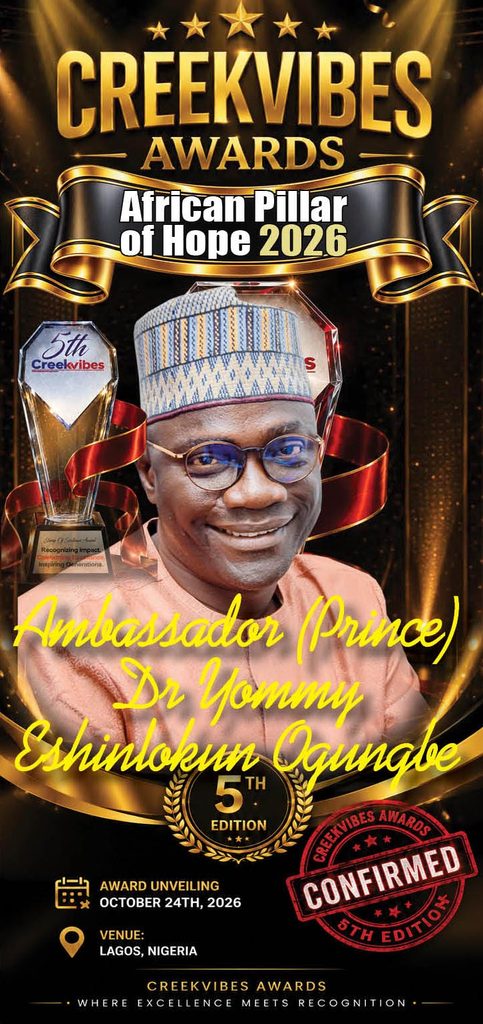
Yommy Eshinlokun Ogungbe: Philanthropist Who Finds Fulfilment in Solving People’s Problems


Through the Imole Eko Foundation, the Lagos-born philanthropist is empowering ordinary Nigerians with practical skills, entrepreneurial opportunities and the confidence to build better lives.
In a society where many people struggle to overcome economic hardship and access opportunities for self-improvement, individuals who dedicate their resources and time to uplifting others stand out as agents of meaningful change. Ambassador Yommy Eshinlokun Ogungbe belongs to this group, whose commitment to humanity shows in their determination to create opportunities for others to succeed.
For Ogungbe, philanthropy goes beyond the occasional distribution of money or material assistance. It is about identifying people’s needs, providing practical solutions and equipping beneficiaries with the knowledge, resources and confidence to become self-reliant. Through the Imole Eko Foundation, he has demonstrated a commitment to empowering people who might otherwise struggle to acquire vocational skills or establish their own businesses.
His philosophy of giving is particularly evident in the foundation’s free vocational training and empowerment programme, which provides participants with opportunities to learn practical trades, develop entrepreneurial abilities and prepare for independent livelihoods.
The initiative reflects a simple but powerful understanding of philanthropy: helping people overcome their immediate challenges while equipping them to confront future difficulties with greater confidence.
Empowerment That Goes Beyond Financial Assistance
One of the defining features of the Imole Eko Foundation’s vocational programme is its emphasis on practical knowledge. Rather than limiting its intervention to financial handouts, the foundation provides training in several trades, including catering, fashion design, cosmetology, hair-making and makeup artistry.
For many beneficiaries, the opportunity represents a turning point. Participants who arrived with little or no prior experience in their chosen fields are acquiring practical skills that can serve as the foundation for future businesses.
The programme also envisages providing successful trainees with startup capital and relevant equipment upon completion of their training, giving them an opportunity to translate their newly acquired knowledge into income-generating ventures.
This combination of training and planned financial empowerment underscores Ogungbe’s apparent belief that sustainable assistance should give people the means to work, earn and improve their circumstances.
The impact of the initiative is evident in the testimonies of participants who spoke with *Creekvibes* during a visit to the foundation’s training centre.
From Learners to Entrepreneurs
In the catering department, a middle-aged woman from Ekiti State described how the training had transformed her understanding of food preparation and baking.
Having spent three months in the programme, she had learnt to prepare pastries such as sausage rolls, egg rolls, meat pies, doughnuts and chin-chin. She had also acquired skills in preparing different rice dishes, soups and stews.
Beyond learning, she had begun practising her new skills, expressing the ambition to establish her own pastry business after receiving financial empowerment. She also intended to leverage social media to promote her products and attract customers.
Her appreciation of the foundation extended beyond commercial prospects. She explained that the knowledge she had acquired would also benefit her husband and family, illustrating how vocational education can improve household welfare as well as create business opportunities.
She described Ogungbe as a man with a generous heart, observing that his willingness to help people could not necessarily be judged by his outward appearance.
Her testimony captured the central message of the foundation’s intervention: people can make meaningful progress when someone gives them an opportunity to discover and develop their abilities.
Building Confidence Through Fashion Design
The tailoring department offers another example of the possibilities created by practical training.
Mrs Eniola Edu, a fashion-design instructor from Epe, Lagos State, brings 15 years of experience to the programme. She explained that her students were steadily improving and that some had begun producing dresses independently.
According to her, the training emphasises consistent practice, with students encouraged to complete garments within a day as their proficiency develops.
For Edu, the greatest satisfaction lies in watching learners acquire skills they once considered beyond their reach. She encouraged women who might be discouraged by age, family responsibilities or a lack of previous experience to pursue vocational training with determination.
Among the beneficiaries is Gift Dickson, an indigene of Kwale in Delta State, who entered the programme without sewing experience. She has since learnt to make trousers, skirts, gowns and other women’s clothing.
Dickson plans to establish a fashion academy in Lagos after completing her training, combining business ownership with the ambition of teaching others.
Another beneficiary, Precious, intends to begin by producing ready-made clothing, testing the market and expanding production as demand grows.
Their aspirations demonstrate the wider potential of Ogungbe’s intervention. By creating an environment where people can acquire practical skills, the foundation is helping beneficiaries envision futures that extend beyond dependence on others.
Cosmetology: Turning Everyday Skills into Business Opportunities
In the cosmetology department, participants are learning to manufacture household and personal-care products, including liquid soap, disinfectants, shampoo, air fresheners, tile cleaners and other cleaning preparations.
Latifat Adepoju, originally from Iseyin in Oyo State, hopes to establish a branded product line after graduation. Her ambition is to register her business and distribute products that meet everyday household needs.
Another participant, Adeola Folashade, spoke about the progress she had made despite initially doubting whether she could master the production processes. She explained that she had begun making some of the products for household use and had identified liquid soap, bathing liquid soap and disinfectant as products she wished to concentrate on commercially.
She also disclosed that she had secured a few profitable liquid-soap supply contracts, giving her practical encouragement to pursue the business further.
For Folashade, the opportunity represents more than vocational education. Having lost her parents at a young age and faced limitations in accessing certain opportunities, she expressed gratitude for the chance to acquire skills that could support her economic independence.
Her experience illustrates how targeted empowerment initiatives can help people recognise possibilities they may previously have considered inaccessible.
Hair-Making: Encouraging Talent and Breaking Stereotypes
The hair-making department further demonstrates the programme’s inclusive approach.
Mrs Vivian Chigbo, an instructor whose interest in hairstyling developed from watching her mother practise the trade, is training participants in wig-making, frontal closure techniques and close ventilation.
She described the experience of teaching at the foundation as rewarding, noting that students were enthusiastic about learning and applying new techniques.
Chigbo also commended the foundation for making training accessible to beneficiaries without charging them tuition fees, while providing instructors with compensation for their work.
One of the students, Bright, an indigene of Akwa Ibom State, has chosen hair-making as a means of earning a living despite the fact that the profession is traditionally perceived in some communities as female-dominated.
He expressed enthusiasm about the prospect of receiving startup support and establishing his own workspace. He also hopes to develop products and services that could eventually reach international markets.
Another beneficiary, Ayinde Oyindamola, credited the training with helping her acquire skills in Ghana weaving and other hairstyling techniques.
These accounts reflect an important dimension of the foundation’s approach: encouraging people to pursue productive ventures regardless of gender stereotypes or their previous level of experience.
Makeup Artistry: Preparing a New Generation of Beauty Professionals
At the makeup and makeover department, instructor Opeyemi Ashafa reported encouraging progress among trainees who had little or no previous experience.
According to her, participants had learnt techniques such as eyebrow shaping and acrylic nail application, with the expectation that their skills would prepare them for future professional opportunities.
Rukayat Abideen, a beneficiary from Kogi State, plans to establish her own beauty studio with other stylists after receiving the necessary equipment and startup support.
She explained that she had begun practising her skills on family members, improving her proficiency in makeup application, nail care, eyelash extensions and headgear styling.
Similarly, Olajuwon Ogungbe, an indigene of Badagry, described how the training had made makeup artistry less intimidating and more enjoyable. She had developed skills in makeup application, gele styling, facial beauty techniques, eyelash extensions and acrylic nails.
She hopes to build her own brand, attract clients and turn her training into a sustainable source of income.
For these beneficiaries, the programme is creating a bridge between learning a trade and establishing a business.
Philanthropy Measured by Human Progress
Across the various departments, a common theme emerges from the testimonies of beneficiaries: gratitude for an opportunity to learn, confidence in their abilities and hope for a more financially secure future.
The programme’s significance lies not only in the individual skills being acquired but also in the potential multiplier effect of the intervention. A graduate who establishes a successful business may eventually employ others, train apprentices, support family members and contribute to the local economy.
Such outcomes are particularly important in communities where access to vocational education and business startup resources can be a major obstacle to self-employment.
For Ogungbe, the value of this form of philanthropy lies in its potential to address problems at their roots. Financial assistance may provide temporary relief, but the acquisition of practical skills can offer a more enduring pathway towards economic independence when supported by access to equipment, capital and markets.
The foundation’s beneficiaries have articulated ambitions that range from opening pastry shops and fashion academies to establishing cosmetology brands, hair studios and makeup businesses. Their plans suggest that the programme is encouraging participants to look beyond training certificates towards practical applications of their knowledge.
Nevertheless, the long-term success of such an initiative will ultimately be measured by the number of graduates who establish viable businesses, sustain their livelihoods and create opportunities for others.
Man of the People
What distinguishes a philanthropist is not simply the resources available for giving, but the willingness to recognise the needs of others and respond with compassion and practical action.
In the accounts of the Imole Eko Foundation’s beneficiaries, Ambassador Yommy Eshinlokun Ogungbe emerges as a benefactor whose intervention has given participants renewed hope and a sense of possibility.
Their appreciation reflects the value they place on being offered an opportunity to learn, develop their talents and work towards financial independence.
His initiative also reinforces the importance of philanthropy that reaches beyond ceremonial gestures to address everyday challenges confronting ordinary people. Whether the need is access to vocational education, the opportunity to acquire a marketable skill or assistance in taking the first steps towards entrepreneurship, interventions of this nature can help people move closer to self-sufficiency.
Ultimately, the story of the Imole Eko Foundation is a story of opportunity, dignity and the human desire to make progress.
For Ambassador Yommy Eshinlokun Ogungbe, the satisfaction of philanthropy is reflected in the prospect of seeing people who once faced limitations develop the confidence to build something of their own.
By investing in skills, nurturing ambition and creating pathways towards entrepreneurship, he is advancing a model of giving in which the beneficiaries are not merely recipients of assistance but potential contributors to their families, communities and the wider economy.
It is a reminder that one of the most meaningful ways to solve people’s problems is to empower them with the knowledge, tools and confidence to begin solving those problems themselves.