
(Video) Omolara Folashade Abimbola Oguntuyi: Female farmers feed the nation


•reach out to people in a positive way, bring smiles into their faces rather than awards
Agriculture is the food bane of all communities, therefore I will say Agriculture creates room for productivity in all ramifications – Oguntuyi.
Omolara Folashade Abimbola Oguntuyi, hailing from Ogun State, Ijebu Ode precisely, her love for Agricultural science right from her secondary school days led her to study Agricultural Animal Science at the prestigious University of Ibadan.
After graduation, she did her National Youth Service Corp with Nigeria Agricultural Cooperative Bank in the heart of Kaduna State. She was employed as a cooperative Officer in the office of the Federal Ministry of Labour Employment and Productivity, not quite-long the department was transferred to the Federal Ministry of Agriculture in 1997, under Water Resources, over to Rural Development and now, it has finally pitched its tent with Food Security.
She found herself in the Federal Ministry of Agriculture amazingly her core roots in no time she started to do what she loved doing, she has been working with the Farmers Cooperative in different aspects.
In 2009, she was reassigned from Lagos to Ogun State, where she spent six and a half years effectively engaging with the Farmers Cooperative. Her efforts not only involved encouraging and mobilising the farmers but also led to a promotion that took her to Abuja in 2016, where she joined the headquarters of the department.
Initially, she worked within the Farmers Organisation before transitioning to the Statutory Department. As a reliable cooperative officer, she managed various cooperative activities in Abuja, which equipped her for more responsibilities.
Subsequently, she was transferred back to the South West Zonal Office, where she was expected to serve as Zonal Director for three years; however, she completed two years in that role. During her time in the office, she actively showcased her dedication to farmers, particularly in Ibadan, where she provided guidance on cultivating yam, cocoyam, and sweet potatoes in bags.
The beautiful yet hardworking Agric top notch officer will be given the award of 2024 Best Co-ordinator Federal Ministry of Agriculture And Food Security Lagos State.
She took a few questions from CREEKVIBES OLUWADAMILARE DANIELS. Excerpts;
You possess knowledge regarding certain vegetables that have medicinal properties. Could you please provide insights on Spinach, Ewedu, and other similar varieties?
One can create smoothies from Spinach vegetables due to their abundant mineral content. For those of us with small gardens at home, spinach is an essential crop. It is advisable to harvest it in the morning and rinse it before using it in smoothies.
Ewedu, known for its natural and organic properties, is particularly beneficial for women nearing labour, as it aids in the delivery process.

Many of us enjoy the taste of Amala accompanied by bean soup and Ewedu, often unaware of the health benefits that Ewedu offers.
In the past, older generations consumed these vegetables regularly, which contributed to increased life expectancy due to major nutrients they provided.
Regarding Okro, its benefits have only recently come to the limelight. It can be soaked in water or blended before consumption. Okro is a vital addition to the mineral consumption. Frequently, we purchase Ewedu that is not organically grown from the market, which may not provide the expected micro nutrients. In contrast, Ewedu cultivated in home gardens using cow or poultry manure tends to be superior, exhibiting a stretchiness that is often lacking in market-bought varieties, which are typically grown with chemical fertilisers.
Our research indicated that upon your resumption at the Oko-Oba office, the employees who had previously exhibited a lackadaisical attitude towards office activities began to arrive punctually. What strategies did you employ to effect this transformation?
I was sceptical when I resumed, there is this belief that they don’t do farming in Lagos, they just buy-eat and buy, so I met with the officers, and I highlighted my moduos operandi, to my amazement, they were all interested, we started from the scratch by getting the top-soil, cow dung these were in the dry season; late January/February that we have to do the wetting of the manure and the soil, we bought 30 tonnes of top-soil.
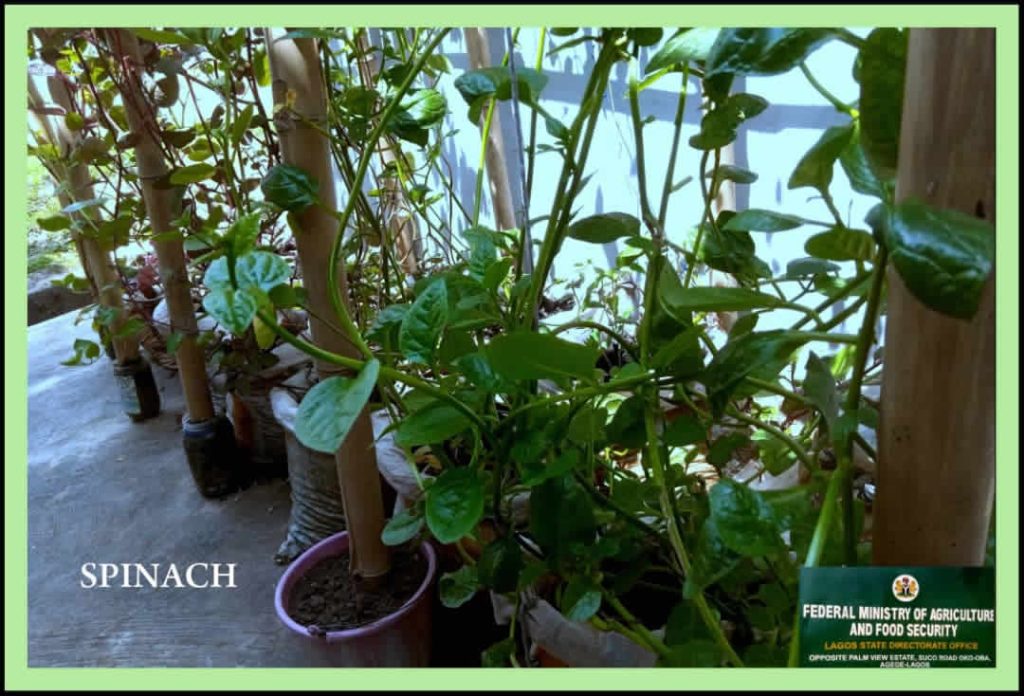
The leftover will be used for the next planting season.
The yams we planted early in the year are all ready for harvest and we will plant another set early next year.
During my visit to Ibadan, I purchased cassava stems and taught them how to plant cassava and produce fufu and cassava flour (Lafun). Although we faced some challenges with Garri production, I successfully demonstrated how to make Fufu.
The excitement they experienced as our plants began to sprout was truly rewarding and it contributed to their overall enthusiasm.
We must also prioritise our health, as physical strength is essential for agricultural work; engaging in farming activities serves as a form of exercise as well.
I am grossly involved in the national Agricultural Growth Scheme (AgroPocket) with the Federal Government in Abuja, once I am back we will harvest and cure the soil.
Once you have the soil, you have a capital investment, all you need is to keep rotating it year in and year out. Also, it is quite important once you harvest, you cure the soil by pouring it on the ground adding manure and soaking it very well then covering it for a while to cure it again.
Could you provide further clarification on the concept of curing?
Curing involves adding manure to the soil, soaking the soil and then covering it with tick nylon for at least one month.
Wetting is essential to allow it to dry before application.
I have engaged in curing for up to three months to eliminate all pests. The covering is typically done with nylon to retain heat, which is crucial for exterminating all the organism in the dung/manure .
What challenges do women encounter in the field of agriculture?
Access to land and financial resources, along with training opportunities, are critical factors in agricultural development. However, there exists a prevailing belief that women should not own land, which constitutes a significant barrier. Often, women engage in small-scale farming not due to a lack of capability to manage larger plots, but rather because of these constraints.
In the event of crop failure due to fire or drought, women typically lack insurance support. In many regions, women bear the responsibility of caring for both children and husbands, which can contribute to an accelerated ageing appearance.
Currently, there is a shift in the narratives; policymakers are beginning to recognise the necessity of providing women with more opportunities in the form of loans. Women are increasingly becoming the primary food producers, as many men have transitioned to processing roles.
For example, erstwhile president Olusegun Obasanjo’s farm produce has a ready market, while older women farmers are now the ones sustaining the nation’s food supply.
Data made available indicates a demographic shift, with 10 men to 30 women involved in agriculture, highlighting that women have taken a leading role in cultivation while men focus on processing.
After your retirement what legacy will you want to be remembered for?
I take great pride in the positive impact I have made by initiating projects that have brought joy to others, enabling them to learn and replicate these efforts. My goal has always been to connect with people. Additionally, as a welfare officer, I prioritise the well-being of my officers under me. These are the contributions I hope I will be remembered for.
What areas do you wish to explore for diversification following your retirement?
I aspire to become a vegetable farmer and a Garri processor. Additionally, I may incorporate Tapioca into my endeavours, as it is also derived from Cassava. However, I will refrain from producing Fufu due to its strong odour. It may surprise you to learn that the unpleasant smell associated with Fufu is often as a result of not changing the water as required.
Can it be asserted that laziness contributes to the odour Fufu produces?
Certainly, I am capable of producing odourless Fufu and cultivating organic vegetables.
I encourage more women to consider engaging in farming, as Garri has become increasingly significant.
How many Nigerian languages do you understand?
Unfortunately, I am deaf to languages. It is primarily when I engage in conversations with farmers that I utilise my language. Aside from basic greetings in Hausa, I am fluent in both my native language and English.
What do you think you have not achieved?
My aspiration is that when my retirement commences, I will finally engage in the one endeavour I have yet to pursue.
How many awards to your credit?
In 2022, I was recognised as one of the top officers in the Ministry of Agriculture and was nominated by the presidency for an Excellence Award from the Office of the Head of Service of the Federation, among other accolades. However, the essence of my work transcends the recognition received; it lies in the impact made on people’s lives.
The true measure of success is how effectively one utilises their position to benefit others.
My guiding principle is to create a positive influence in my immediate surroundings, to engage with individuals constructively, and to bring joy to their lives, rather than solely seeking awards.